
NSW New Home Site Costs 2026
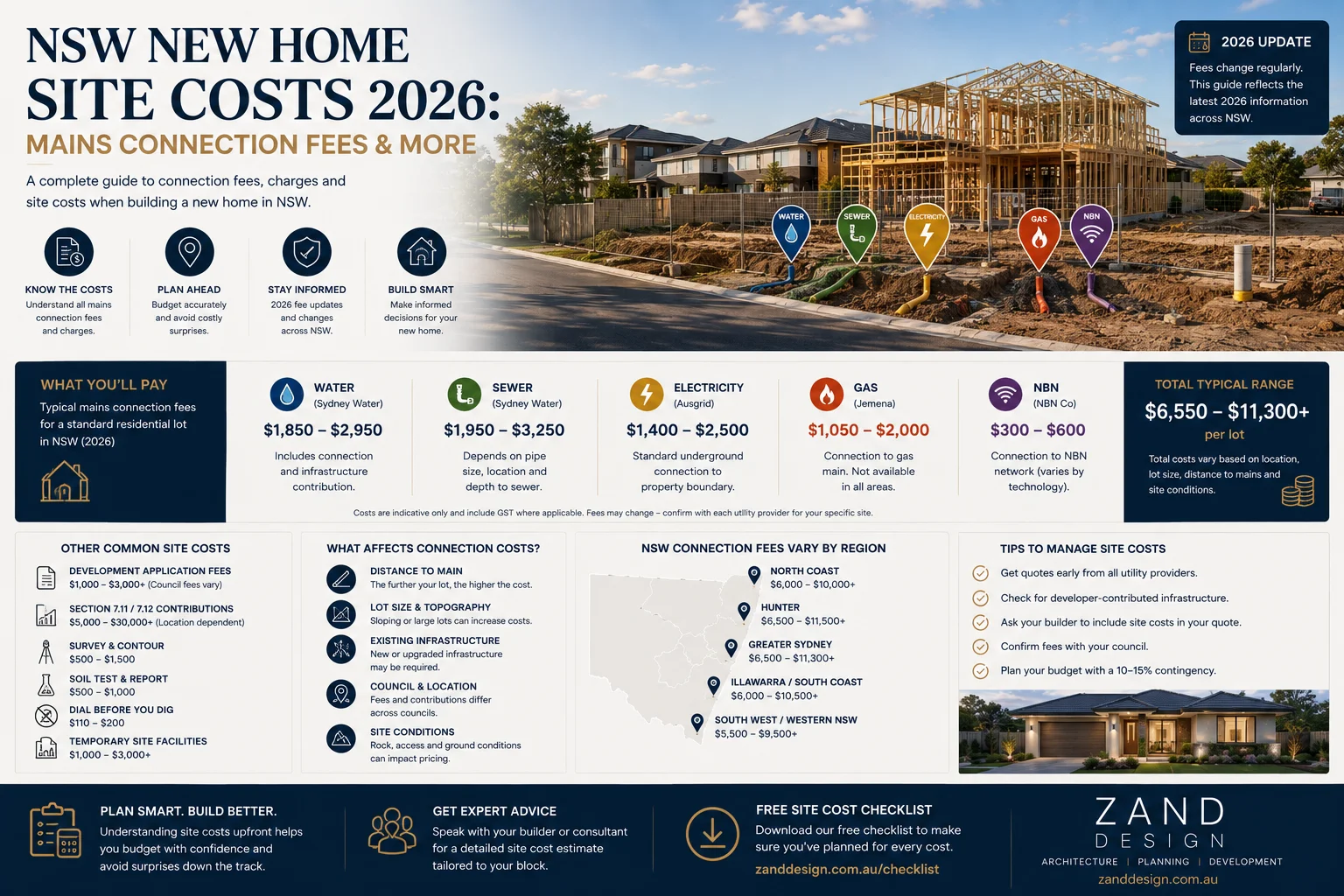
When planning a new home in NSW, it is easy to focus on the construction price and overlook everything that needs to happen before and around the building itself.
The cost of the house is only one part of the budget.
Before construction can properly get underway, the site may need to be surveyed, tested, cleared, excavated and connected to essential services. Depending on the property, you may also need retaining walls, stormwater works, additional engineering, council approvals or infrastructure contributions.
This is why two blocks with a similar purchase price can end up with very different construction budgets.
In this guide, we look at the main site costs involved in building a new home in NSW in 2026, with particular attention to mains connections, site conditions and the costs that are commonly overlooked during the early stages of a project.
What Are Site Costs When Building a New Home in NSW?
Site costs are essentially the costs associated with preparing the land and making it suitable for your new home.
They sit alongside the actual construction cost rather than replacing it.
Some of the work may happen before construction starts, while other costs become clear once the site is investigated in more detail.
For example, a straightforward suburban block with good soil, relatively flat ground and existing services close to the property may require fairly simple preparation.
A different block may have a significant slope, sandstone, poor soil, difficult access or drainage constraints. In that situation, excavation, retaining, engineering and service connections can make a substantial difference to the overall budget.
The NSW Planning Portal recommends checking early whether items such as surveys and geotechnical reports are included in a builder’s package, because they may otherwise need to be arranged separately.
How Much Do Site Costs Add to a New Home in NSW?
There is no reliable single figure for NSW site costs.
That is one of the most important things to understand before using an online average to budget for a new home.
The cost of preparing a block depends heavily on what is actually on the land and what is available around it.
A relatively flat and well-serviced site may require little additional work. A steep site with rock, difficult access and limited services can be a completely different proposition.
For this reason, it is usually more useful to think about site costs as a collection of potential expenses rather than one fixed allowance.
The early investigations are particularly important because they give you information about the things that can materially change the design and construction method.
Mains Connection Fees for a New Home in NSW
Connecting a new home to essential services is one of the areas where homeowners often underestimate the difference between a published connection fee and the actual cost of getting the service working on the property.
Electricity, water, sewer, gas and telecommunications can each involve different providers, requirements and site conditions.
Electricity Connection
A new home may require a new electricity connection, an upgrade to an existing connection or additional work between the network and the building.
The final cost can depend on factors such as the location of the property, the existing network, the type of connection required and whether additional network work is necessary.
There is therefore no single NSW-wide new home electricity connection fee that applies to every property.
This is particularly important when comparing building estimates. A basic allowance for an ordinary connection should not automatically be treated as a guarantee of the final cost.
Before finalising the construction budget, the electrical contractor and relevant electricity distributor should confirm what the property actually requires.
Water Connection
Water connection costs are a little easier to understand because Sydney Water publishes its current charges for Greater Sydney.
For the 2026–27 financial year, Sydney Water lists a 20–25 mm simple water connection as free, while a 25 mm complex or larger connection is $457.99. The application for water connection approval is also listed as free.
That does not mean every new home can simply budget $0 or $457.99 for water.
The published connection charge is only one part of the picture. Physical connection works, private plumbing and other site-specific requirements can affect the total project cost.
This distinction between an official connection fee and the total cost of servicing a property is important when preparing a realistic budget.
Sewer Connection
Sewer requirements depend on the property and the existing wastewater infrastructure.
Sydney Water currently lists the application for a new wastewater connection point as free. However, the actual work required to connect a property to the sewer system can involve additional costs depending on the circumstances of the site.
For a new home, it is therefore worth confirming the existing connection point, sewer location and any requirements affecting the proposed building before construction begins.
Gas Connection
Gas is becoming more project-specific as more new homes use electric appliances, heat pumps and induction cooking.
If gas is part of your design, check whether mains gas is available to the property and what connection and installation work will be required.
If it is not essential to the design, there may be an opportunity to avoid an additional service connection altogether.
The Site Conditions That Can Change Your Budget
The biggest surprises in a new-home budget often come from the ground rather than the house.
Soil
The type and condition of the soil can influence the way the house needs to be founded.
Reactive clay, fill, sand, rock and other ground conditions can require different engineering solutions.
This is why a geotechnical investigation can be valuable before the design and construction budget are locked in.
The NSW Planning Portal specifically notes that geotechnical reports help identify subsurface conditions such as rock, sand and clay, which can affect how the house is constructed.
Sloping Land
A sloping block can be beautiful from a design perspective, but it can also introduce additional construction complexity.
Depending on the site, the project may require more excavation, retaining walls, specialised foundations and more complicated stormwater management.
The important point is not that every sloping block is expensive.
Good architectural design can work with the natural levels of a site. The problem comes when the design, engineering and site conditions are considered separately rather than as one system.
Rock
Rock is another factor that can quickly change an excavation allowance.
If significant rock is encountered where foundations, drainage or services need to be installed, specialised excavation methods may be required.
The cost is not simply the excavation itself. There can also be additional labour, machinery, transport and spoil disposal.
Access
Access is easy to overlook when looking at a block from the street.
A narrow frontage, restricted side access or limited space for machinery can affect how materials and equipment reach the construction area.
This can become particularly relevant on established Sydney properties where neighbouring buildings, fences and existing landscaping limit the available working area.
Surveys and Investigations Before Construction
A good site investigation is one of the best ways to reduce uncertainty.
A detailed survey can establish the boundaries, levels, existing structures and other physical features that influence the design.
A geotechnical report can provide information about what lies beneath the surface.
These investigations are not just paperwork.
They allow the architect and engineering team to understand the site before making important decisions about floor levels, foundations, excavation, drainage and the position of the building.
The NSW Planning Portal advises homeowners to check whether a required survey is included in the builder’s package and notes that preliminary builder fees and geotechnical investigations can depend on the land and project.
Council, Planning and Certification Costs
Not every cost associated with a new home is a physical construction cost.
Depending on your project, there can also be planning, certification and government fees.
These may involve a Development Application or Complying Development Certificate, Construction Certificate, Occupation Certificate, BASIX and other approval-related charges.
It is important to distinguish between NSW Planning Portal service fees and the much broader fees charged by councils, certifiers and consultants.
For 2026–27, the NSW Planning Portal lists a $43 portal fee for submitting a Complying Development Certificate and a $47 portal fee for a Construction Certificate. A BASIX certificate application has a $5 Planning Portal fee. These are portal service fees and are separate from council or private certifier charges.
The Planning Portal also updated its planning service fee structure from 1 July 2026 in line with the annual CPI adjustment.
BASIX and the Cost of Designing the Home
BASIX is not really a site cost in the traditional sense, but it belongs in the early project budget because it can influence the design and specification of the home.
The current BASIX standards affect areas including thermal performance, energy use and water efficiency.
In 2026, the BASIX system also received further technical and functionality updates, including changes to the way new-home assessments and reports handle thermal performance and other information.
The important point for a homeowner is that sustainability requirements can influence design decisions.
Window selection, insulation, glazing, hot water systems, solar panels and other elements can all interact with the performance requirements of the home.
So while the BASIX certificate itself is only one small line in the budget, the design decisions needed to achieve the required performance can have a much larger effect.
Housing and Productivity Contribution
For some developments in NSW, another cost that needs to be investigated is the Housing and Productivity Contribution (HPC).
It does not apply universally to every new house, and the amount depends on the location and type of development.
For example, the indexed base component published by the NSW Planning Portal from 1 January 2026 for Greater Sydney is $12,974.62 per new dwelling lot for residential subdivision and $10,812.18 per new dwelling for medium or high-density residential development. Different rates apply in other areas, and additional components can apply in specific locations.
This is particularly relevant when looking at duplex, multi-residential or subdivision projects.
For a standard single dwelling, you should not simply assume that one of these rates applies. The development needs to be assessed against the relevant NSW planning rules.
Are Site Costs Included in a Builder’s Quote?
This is one of the questions we recommend asking before comparing building prices.
Two builders can provide apparently similar construction prices while making very different assumptions about the site.
One quote might include a standard allowance for excavation and connections. Another might exclude certain works until the site has been investigated.
That difference can make an inexpensive quote look cheaper than it really is.
Before signing a contract, ask exactly what the price includes in relation to:
- excavation and earthworks
- rock
- soil conditions
- retaining
- stormwater
- utility connections
- site access
- external works
- approvals and certification
You do not necessarily need every cost to be known on day one. What matters is understanding which items are confirmed, which are allowances and which remain unknown.
How to Estimate Site Costs Before Designing Your Home
The best time to investigate site costs is before the design becomes too advanced.
Start by understanding the property itself.
Look at the existing levels, access, services, easements, drainage and surrounding conditions. Then obtain the appropriate survey and geotechnical information.
Once those constraints are understood, the architect can design the house around the site rather than forcing the site to accommodate an unsuitable design.
This can make a meaningful difference.
For example, a design that works with the natural slope may reduce unnecessary excavation and retaining. Similarly, positioning the house with existing services in mind can help avoid unnecessary complications.
The objective is not simply to find the cheapest possible site solution. It is to make informed design decisions before expensive construction decisions have already been made.
What Should You Budget for in 2026?
Rather than starting with a generic percentage, we recommend building your site budget around the actual property.
For a new home in NSW, investigate the likely cost of:
Site investigations: survey, soil testing and geotechnical information.
Groundworks: clearing, excavation, earthworks and potential rock removal.
Structural site requirements: foundations, retaining and engineering resulting from the site conditions.
Services: electricity, water, sewer, gas and telecommunications.
Drainage: stormwater and any site-specific drainage infrastructure.
Approvals: planning, certification, BASIX and applicable government or council charges.
External works: driveway, crossover, fencing, landscaping and other items outside the main building.
The reason for approaching the budget this way is simple: there is no meaningful average site cost that can accurately describe every block in NSW.
A good budget reflects the actual site.
Sydney vs Regional NSW: Are Site Costs Different?
They can be, but location alone does not determine the cost.
Sydney properties can have difficult access, tight sites, existing structures and complicated urban conditions.
Regional properties can have different challenges, particularly where infrastructure is less accessible or where the distance from suppliers and contractors affects the project.
A flat, well-serviced block outside Sydney may therefore be easier to build on than a constrained inner-Sydney site.
The opposite can also be true.
The key question is not simply Is the property in Sydney?
It is:
What does this particular site require?
Final Thoughts
When budgeting for a new home in NSW, the construction price should never be considered in isolation.
The site itself has a major role to play.
Soil, slope, rock, access, drainage and existing services can all influence the final cost. Mains connections are another important part of the equation, but even here, a published connection fee does not necessarily represent the total cost of getting a service connected and ready for the new home.
The most reliable approach is to investigate the property early, understand its constraints and allow the design to respond to those conditions.
At Zand Design, we see the site as part of the architecture rather than simply the piece of land underneath it. Understanding the site early allows the design, engineering and budget to work together before construction begins.
Frequently Asked Questions
What are site costs when building a new home in NSW?
Site costs are the expenses associated with preparing the land and connecting it to the services required for the new home. They can include surveys, soil testing, excavation, retaining, drainage, utility connections and certain approval-related costs.
How much do site costs cost in NSW in 2026?
There is no fixed NSW-wide amount. The cost depends on the property’s soil, slope, access, existing services, drainage, planning requirements and the design of the home.
How much does it cost to connect water to a new home in NSW?
For Sydney Water’s 2026–27 pricing, a standard 20–25 mm simple water connection is listed as free, while a 25 mm complex or larger connection is listed at $457.99. Other project and physical connection costs may still apply.
Are mains connection fees included in a builder’s price?
Not always. Some builders include allowances for standard connections while others exclude certain connection or site-related costs. Always check the inclusions and exclusions in the building proposal.
Does a sloping block cost more to build on?
It can. Sloping land may require additional excavation, retaining, drainage, engineering and more complex foundations. However, good design can sometimes work with the natural levels of the site.
Does rock increase construction costs?
Potentially. Rock can require specialised excavation equipment and additional work for foundations, drainage and service installation.
Do I need a geotechnical report?
It depends on the property and project. A geotechnical report can be particularly valuable where soil conditions, slope or other ground conditions could affect the way the house is designed and constructed.
What should I ask my builder about site costs?
Ask which site-related items are included, which are allowances and which are excluded. Pay particular attention to excavation, rock, retaining, drainage, utility connections and external works.